| wiki1321: Vmm_data_structures (Version 3) | ||
|
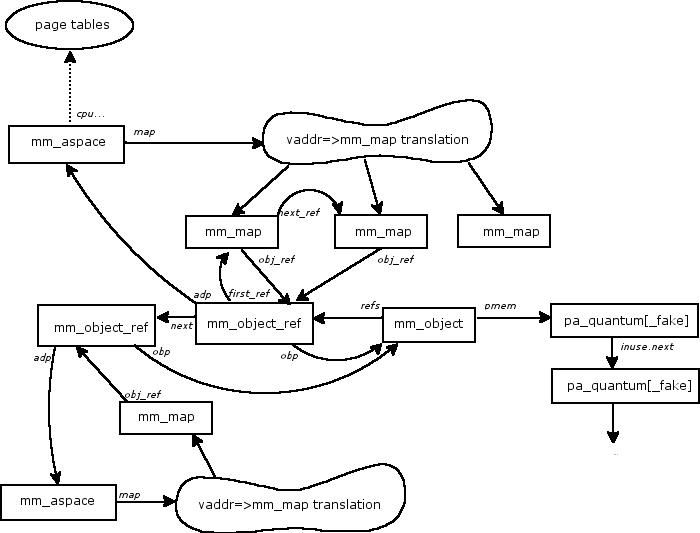
base memory object#The object structure is shared between both the pathmgr and memmgr components of procnto. They mostly keep to themselves, but there were a couple of places where interface breaking goes on - these are marked with comments in the source.
struct mm_object {
	struct object_header        hdr;

	struct pathmgr_stuff {
		 time_t                  mtime;
		 mode_t                  mode;
		 uid_t                   uid;
		 gid_t                   gid;
	}       pm;

	struct memmgr_stuff {
		struct proc_mux_lock    *mux;
		struct pa_quantum       *pmem;
		struct pa_quantum       **pmem_cache;
		struct mm_object_ref    *refs;
		struct pa_restrict      *restrict;
		off64_t                 size;
		unsigned                flags;
	}       mm;
};
The pm fields are for use by path manager.
OBJECT_MEM_ANON#
struct mm_object_anon {
	struct mm_object    mem;
};
OBJECT_MEM_SHARED#
struct mm_object_shared {
	struct mm_object    mem;
	volatile unsigned   name_refs;
	unsigned            special;
	intptr_t           vaddr;
};
OBJECT_MEM_FD#
struct mm_object_fd {
	struct mm_object    mem;
	int                 fd;
	time_t              ftime;
	ino_t               ino;
	dev_t               dev;
	char                *name;
	unsigned            pending_dones;
};
OBJECT_MEM_TYPED#
struct mm_object_typed {
	struct mm_object_shared shmem;
	char                    *name;
};
mm_aspace (ADDRESS)#
struct mm_aspace {
	struct mm_map_head          map;
	struct  {
		uintptr_t       vmem;
		uintptr_t       data;
		uintptr_t       stack;
		uintptr_t       memlock;
		uintptr_t       rss;
	}                           rlimit;
	OBJECT                      *anon;
	struct _memmgr_rwlock       rwlock;
	unsigned                    fault_owner;
	unsigned                    flags;
	uintptr_t                   tmap_base;
	size_t                      tmap_size;
	struct cpu_mm_aspace        cpu;
};
mm_map#
struct mm_map {
	struct mm_map           *next;
	struct mm_object_ref    *obj_ref;
	off64_t                 offset;
	struct {
		struct mm_map           *next;
		struct mm_map           **owner;
	}						ref;
	uintptr_t               start;
	uintptr_t               end;
	int                     reloc;
	unsigned                mmap_flags;
	unsigned                extra_flags;
	unsigned short          last_page_bss;
	uint8_t                 spare;
	volatile uint8_t        inuse;
};
mm_object_ref#
struct mm_object_ref {
	struct mm_object_ref    *next;
	struct mm_aspace        *adp;
	OBJECT                  *obp;
	struct mm_map           *first_ref;
	int                     fd;
};
pa_quantum#
struct pa_free_link {
	struct pa_quantum   *next; // must be first entry
	struct pa_quantum   **owner;
};

struct pa_inuse_link {
	struct pa_quantum   *next; // must be first entry
	_Uint32t            qpos;
};

struct pa_quantum {
	union {
		struct pa_inuse_link    inuse;
		struct pa_free_link     flink;
	}           u;
	_Int32t     run;
	_Uint16t    blk;
	_Uint16t    flags;
};
pa_quantum_fake#
struct pa_quantum_fake {
	struct pa_quantum   q;
	paddr_t             paddr;
};
Since the physical memory list of an object must be made up of quantums, and we only allocate enough pa_quantum's to cover the system ram for a box, something special has to be done when the user requests a direct physical mapping. In those cases, we create a pa_quantum_fake. These differ from a normal pa_quantum in that they have a paddr field attached to them to give the physical address (normal pa_quantum's obtain the physical address from information in the block head structure) and the fact that
no matter how many pages the mapping is for, only one pa_quantum_fake structure is allocated, as opposed to the array of pa_quantum's that would be used to cover the same amount of physical memory. Code can tell the difference between the two by the fact that pa_quantum_fake's blk field is set to PAQ_BLK_FAKE.
|
||

 Show Details